
The First Continental Congress
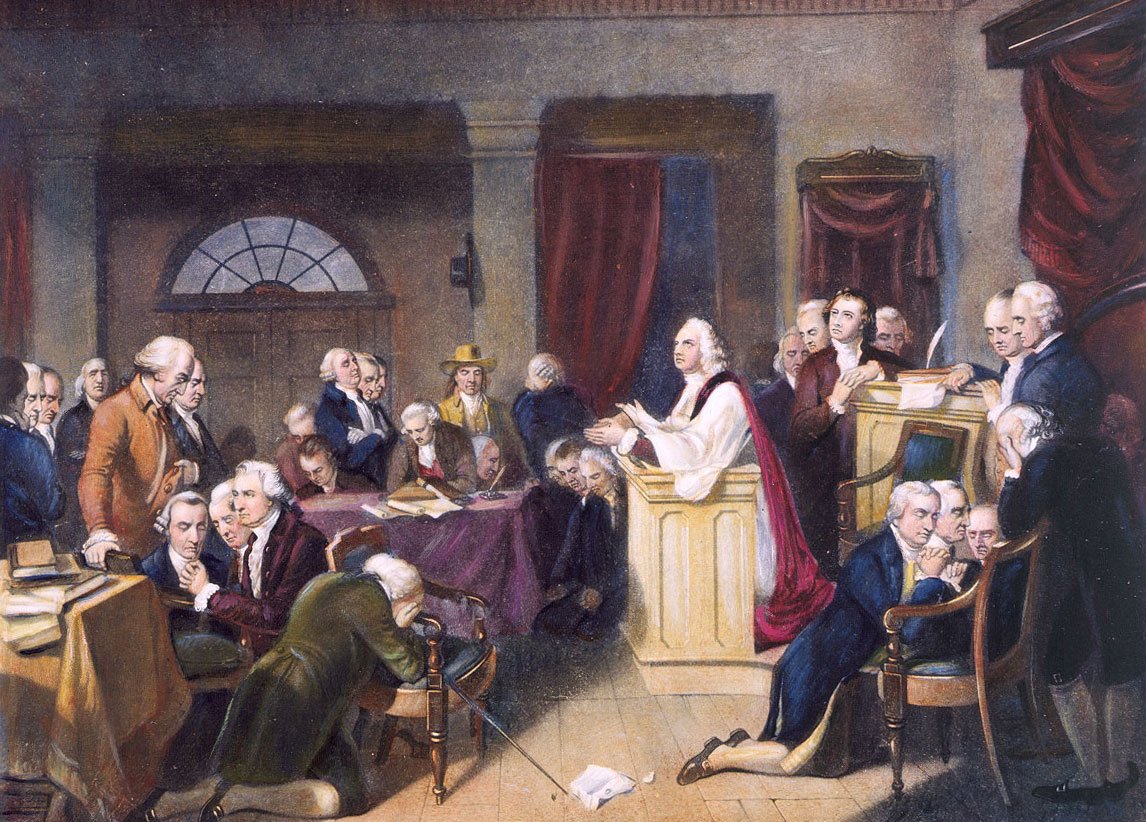
By Henry Samuel Sadd - https://www.loc.gov/pictures/item/2006676690/, Public Domain, https://commons.wikimedia.org/w/index.php?curid=155299143
As part of Lodestone’s yearlong celebration of The United States of America 250th year, I have prepared a lecture entitled “The Miracle of America” for the LTAC Tuesdays in June. I thank my Father in Heaven for this great Nation and acknowledge his hand in its establishment.
“The Man must be bad indeed who can look upon the events of the American Revolution without feeling the warmest gratitude towards the great Author of the Universe whose divine interposition was so frequently manifested in our behalf.”
—Washington’s letter to Samuel Langdon, September 28, 1789
I’d like to share with you the account of what happened at the official start of what would become the United States of America. The several colonies sent representatives in the fall of 1774 for the first Continental Congress. This was just after the British Navy implemented a blockade of Boston Harbor and the Parliament of Great Britain passed the punitive Intolerable Acts in response to the Boston Tea Party. The delegates all agreed to the suggestion that they start with a prayer, but since they were from all kinds of different Christian faiths that had a long history of fighting each other, this just led to disagreements. They were meeting as representatives of the colonies, trying to figure out what to do with the problem of England, yet they were doomed to failure because they couldn’t even unite on how to start.
Samuel Adams ultimately shifted the debate. Now, Sam Adams was a real tough guy from Boston. He had been knee-deep in resisting the English for years and was known as a scrapper. He also was from Puritan descent. Why did the Pilgrims/Puritans come to America? To get away from the Church of England.
Rising during the discussion, he insisted that he “could hear a prayer from any gentleman of piety and virtue who is a friend to his country,” an argument that reframed the issue as one of unity rather than doctrine. Adams’ intervention reassured delegates across denominational lines. He then nominated Jacob Duché to say the prayer. Jacob Duché was an Anglican (Church of England) clergyman and representative from Pennsylvania. Many were astonished at what Adams did. A Puritan nominating an Anglican?!? It was unanimously agreed.
Now, think about it. This was the first official act of what would become the United States of America. On the morning of September 7th 1774, Jacob Duché opened his “Book of Common Prayer” (First published in 1549, this was a book with a psalm, prayer, or scripture for each day of the year). The “prayer” for September 7th was Psalm 35.
A Psalm of David.
1 Plead my cause, O Lord, with them that strive with me: fight against them that fight against me.
2 Take hold of shield and buckler, and stand up for mine help.
3 Draw out also the spear, and stop the way against them that persecute me: say unto my soul, I am thy salvation.
4 Let them be confounded and put to shame that seek after my soul: let them be turned back and brought to confusion that devise my hurt.
5 Let them be as chaff before the wind: and let the angel of the Lord chase them.
6 Let their way be dark and slippery: and let the angel of the Lord persecute them.
7 For without cause have they hid for me their net in a pit, which without cause they have digged for my soul.
8 Let destruction come upon him at unawares; and let his net that he hath hid catch himself: into that very destruction let him fall.
9 And my soul shall be joyful in the Lord: it shall rejoice in his salvation.
10 All my bones shall say, Lord, who is like unto thee, which deliverest the poor from him that is too strong for him, yea, the poor and the needy from him that spoileth him?
11 False witnesses did rise up; they laid to my charge things that I knew not.
12 They rewarded me evil for good to the spoiling of my soul.
13 But as for me, when they were sick, my clothing was sackcloth: I humbled my soul with fasting; and my prayer returned into mine own bosom.
14 I behaved myself as though he had been my friend or brother: I bowed down heavily, as one that mourneth for his mother.
15 But in mine adversity they rejoiced, and gathered themselves together: yea, the abjects gathered themselves together against me, and I knew it not; they did tear me, and ceased not:
16 With hypocritical mockers in feasts, they gnashed upon me with their teeth.
17 Lord, how long wilt thou look on? rescue my soul from their destructions, my darling from the lions.
18 I will give thee thanks in the great congregation: I will praise thee among much people.
19 Let not them that are mine enemies wrongfully rejoice over me: neither let them wink with the eye that hate me without a cause.
20 For they speak not peace: but they devise deceitful matters against them that are quiet in the land.
21 Yea, they opened their mouth wide against me, and said, Aha, aha, our eye hath seen it.
22 This thou hast seen, O Lord: keep not silence: O Lord, be not far from me.
23 Stir up thyself, and awake to my judgment, even unto my cause, my God and my Lord.
24 Judge me, O Lord my God, according to thy righteousness; and let them not rejoice over me.
25 Let them not say in their hearts, Ah, so would we have it: let them not say, We have swallowed him up.
26 Let them be ashamed and brought to confusion together that rejoice at mine hurt: let them be clothed with shame and dishonour that magnify themselves against me.
27 Let them shout for joy, and be glad, that favour my righteous cause: yea, let them say continually, Let the Lord be magnified, which hath pleasure in the prosperity of his servant.
28 And my tongue shall speak of thy righteousness and of thy praise all the day long.
John Adams wrote that the psalm “thrilled through the whole assembly,” and Charles Thomson observed that it “seemed wonderfully adapted to the circumstances of America.”
Then Duché knelt to pray.
“O Lord our Heavenly Father, high and mighty King of kings, and Lord of lords, who dost from thy throne behold all the dwellers on earth and reignest with power supreme and uncontrolled over all the Kingdoms, Empires and Governments; look down in mercy, we beseech Thee, on these our American States, who have fled to Thee from the rod of the oppressor and thrown themselves on Thy gracious protection, desiring to be henceforth dependent only on Thee. To Thee have they appealed for the righteousness of their cause; to Thee do they now look up for that countenance and support, which Thou alone canst give. Take them, therefore, Heavenly Father, under Thy nurturing care; give them wisdom in Council and valor in the field; defeat the malicious designs of our cruel adversaries; convince them of the unrighteousness of their Cause and if they persist in their sanguinary purposes, of own unerring justice, sounding in their hearts, constrain them to drop the weapons of war from their unnerved hands in the day of battle!
Be Thou present, O God of wisdom, and direct the councils of this honorable assembly; enable them to settle things on the best and surest foundation. That the scene of blood may be speedily closed; that order, harmony and peace may be effectually restored, and truth and justice, religion and piety, prevail and flourish amongst the people. Preserve the health of their bodies and vigor of their minds; shower down on them and the millions they here represent, such temporal blessings as Thou seest expedient for them in this world and crown them with everlasting glory in the world to come. All this we ask in the name and through the merits of Jesus Christ, Thy Son and our Savior.
Amen.”
Delegates wrote home describing the moment as deeply unifying and emotionally charged. Many openly wept while he prayed. John Adams told Abigail Adams that the prayer “filled the bosom of every man present,” and Richard Henry Lee called the scene “one of the most touching prayers I have ever heard.”
That was the start of our Nation under God. That is the humility and faith we need now more than ever if we are going to preserve our Republic. I encourage you to think on this prayer, psalm, our founding fathers, the principles in the Declaration of Independence and our sacred Constitution. I encourage you to get on your knees and thank God. Then ask him what he would have you do.
— Jared Ross